Are Your Unit Sizes Competing Against Each Other?

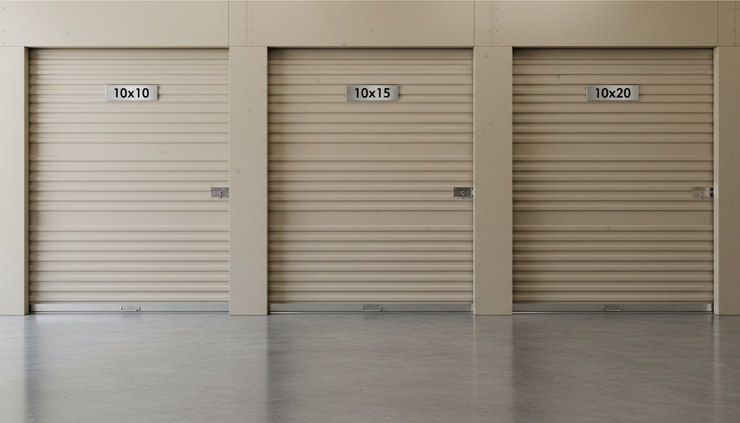
A storage customer does not shop a 10x10 in isolation. They see a row of choices. The 10x10, 10x15, 10x20, climate, non-climate, drive-up, interior, upstairs, downstairs. The decision happens across that spread.
That is why pricing architecture matters. A rate can look right for one unit type and still create problems across the facility. The issue is not only whether each size is priced high or low. The issue is how neighboring sizes relate to one another, and how those relationships shape demand.
Unit prices create a ladder that customers read quickly
Most self-storage pricing decisions start with unit type performance. That is useful. Occupancy, move-in rate, web rate, street rate, length of stay, discounting, and availability all matter.
But the customer sees a price ladder.
A price ladder is the relationship between one size and the next. It tells the customer what extra space costs. It also tells the customer where the obvious value sits.
For example:
Unit | Floor area | Monthly rate |
10x10 | 100 sq. ft. | $149 |
10x15 | 150 sq. ft. | $159 |
10x20 | 200 sq. ft. | $219 |
The 10x15 has 50% more floor area than the 10x10. In this example, it costs only $10 more per month. That does not automatically make the 10x15 underpriced. It may be the right decision in a specific context. But the relationship is powerful.
A customer who planned to rent a 10x10 may ask a simple question.
Why not take the 10x15?
That question can change the demand pattern for the whole unit mix.
This is where revenue management in self storage needs to look beyond individual unit categories. The unit mix acts like a connected system. A small shift in one rate can pull demand from one size, push demand toward another, or change the pace at which available inventory gets absorbed.
Incremental space value changes the choice
Customers do not always calculate price per square foot. Many do not know how much space they need. They use cues.
Those cues include:
The rental page order
Size guide descriptions
Photos and diagrams
Available promotions
Climate versus non-climate labels
Monthly price differences
Whether the next size up feels like a bargain
The most important cue is often the incremental cost of more space.
If a 10x10 is $149 and a 10x15 is $159, the customer is not comparing $149 to $159 in a vacuum. They are comparing 100 square feet to 150 square feet. That $10 difference may feel small enough to reduce the risk of renting too little space.
Self-storage customers often fear two outcomes:
Renting a unit that is too small, then having to transfer.
Paying for space they do not use.
When the next size up carries only a small premium, the first fear may dominate. The larger unit becomes a safer choice. That can be good if the goal is to absorb larger inventory. It can be costly if the 10x15 had stronger long-term revenue potential or if the facility later runs short on that size.
The reverse can also happen. If the step from 10x10 to 10x15 feels too large, customers may compress demand into the smaller unit. That can constrain 10x10 inventory faster than expected, even when 10x15s remain available.
The point is not to set a standard gap. Markets differ. Facility layouts differ. Customer demand differs. The point is to read the ladder as a decision path.
Availability can make a price relationship more or less dangerous
Price relationships matter most when availability differs across neighboring sizes.
Take a hypothetical facility with these conditions:
Unit type | Current position | Web rate |
5x10 | Tight availability | $99 |
10x10 | Constrained availability | $149 |
10x15 | Healthy availability | $159 |
10x20 | Available | $219 |
The 10x15 sits only slightly above the 10x10. The 10x10 is constrained. The 10x15 still has inventory.
A customer looking for a 10x10 may move up. That may help protect the constrained 10x10 inventory. It may also reduce friction at the point of sale, because the customer gets more room for a small increase.
But the same setup can create second-order effects.
If too many 10x10 shoppers move into 10x15s, the facility may rent larger units to customers who would have accepted less space. That can reduce future availability for customers who truly need the 10x15. It can also change future rate pressure. The property may enter the next pricing cycle with constrained mid-size units and more availability elsewhere.
Changing the 10x10 rate can also affect 10x15 demand.
If the 10x10 rises from $149 to $159 while the 10x15 stays at $159, the customer sees no price step. A 10x15 becomes the obvious choice if available. That may be acceptable for a short period if the facility wants to steer demand up. But if the outcome is accidental, the facility can lose control of the unit mix.
If the 10x15 rises instead, some customers may stay with the 10x10. That can worsen the 10x10 constraint. It may also increase lost rentals if shoppers find no suitable lower-priced alternative.
One rate change can shift demand in several directions.
Occupancy alone does not explain the ladder
Occupancy is a key signal. It is not the whole answer.
A 10x10 and a 10x15 can have the same occupancy and still require different pricing actions. The reason is future availability, recent rental pace, customer substitution, and the shape of the rest of the unit mix.
A unit type at 92% occupied may be in a strong position if only a few units remain and demand is steady. Another unit type at 92% may be weaker if several move-outs are scheduled, rental pace has slowed, or a nearby size offers better value.
Look at the ladder through several questions:
Which sizes are customers seeing next to each other online?
Which sizes can substitute for one another in a real move?
Which sizes are constrained now?
Which sizes will become constrained if current rental pace continues?
Where does the next size up look unusually attractive?
Where does the next size down create a cheaper escape route?
This is where self storage pricing, unit size pricing, price ladder, unit mix, storage rate optimization all connect. The rate is not only a number attached to a unit. It is a signal inside a choice set.
Customer substitution is not always obvious
Substitution does not happen evenly across the unit mix.
A 5x5 customer may not substitute into a 10x20. A 10x20 customer may not squeeze into a 5x10. But demand can move across neighboring or near-neighboring sizes.
Common substitution paths include:
5x10 to 10x10 for apartment overflow
10x10 to 10x15 for household goods
10x15 to 10x20 for larger moves
10x20 to 10x30 for vehicle storage or full-home storage
Non-climate to climate when the premium feels reasonable
Climate to non-climate when budget becomes the main constraint
Substitution also depends on how the facility presents unit sizes. A call center agent, website size guide, or manager recommendation can change the path. If the customer is unsure, the option that feels like the best value often wins.
A narrow price step can create a value anchor. A wide step can create resistance. Promotions can magnify both effects.
For example, if a 10x10 has no promotion but a 10x15 has the first month discounted, the effective first-month difference may be even smaller than the listed rates suggest. A customer may rent the 10x15 even if the standard monthly rate is higher. That can be a valid tactic, but it should be intentional.

Climate and non-climate units can compete across category lines
Facilities often evaluate climate-controlled and non-climate units separately. That makes sense for operating cost, build type, and customer need. But customers may still compare them.
A 10x10 climate unit and a 10x15 non-climate unit can compete if they appear near each other in price. A customer storing durable goods may choose more non-climate space. A customer storing wood furniture, documents, electronics, or temperature-sensitive items may choose climate even with less space.
The pricing architecture should reflect more than size. It should reflect the value of:
Climate control
Interior access
Drive-up access
Ground-floor location
Elevator access
Door size
Vehicle suitability
Security perception
Convenience
Unusual relationships across these attributes can influence behavior.
A climate 10x10 priced below a non-climate 10x10 may move demand into climate inventory faster than planned. A drive-up 10x15 priced close to an interior 10x10 may pull customers who care about access. A second-floor climate unit may need a different relationship to a ground-floor non-climate unit than a simple size comparison would suggest.
The customer does not care how the revenue report groups the unit. The customer cares which option solves the problem at the best perceived value.
Unusual price relationships are not always mistakes
A strange-looking ladder is not automatically wrong.
There are valid reasons for unusual price relationships:
A facility may need to rent down a large pocket of available inventory.
A size may have weak local demand due to housing patterns or business use.
Competitors may be aggressive on a specific size.
A unit type may have access limitations.
A climate or floor-level difference may change perceived value.
A facility may be protecting scarce smaller units for future demand.
A 10x15 priced close to a 10x10 may be a deliberate demand-shaping move. It may help fill available larger units while preserving constrained smaller inventory. It may also improve close rates for uncertain shoppers.
The problem appears when the relationship is not reviewed as part of the full ladder.
A single rate can look justified by occupancy. It can also create a substitution path that weakens another part of the facility. This is why pricing review should include both vertical and horizontal checks.
Vertical checks ask how one unit type is performing over time.
Horizontal checks ask how that unit type compares with nearby choices today.
Both matter.
What to review before changing one rate
A strong pricing review should answer practical questions before changing a web rate, street rate, or promotion.
Start with the customer’s view. Pull up the same rental path a shopper sees. Compare neighboring sizes, not only report rows.
Then review the operating signals:
Question | Why it matters |
Which unit types are nearly full? | Scarcity can justify stronger rate posture, but it can also push demand elsewhere. |
Which unit types have available inventory? | Availability may support more aggressive positioning if demand needs direction. |
Which sizes substitute in real rentals? | The closest substitute may not be the next size in the report. |
Which options sit near each other in price? | Tight gaps can change the customer’s sense of value. |
Which rates include promotions? | Discounts can alter the effective ladder. |
Which attributes change value? | Climate, access, floor, and door type can outweigh square footage. |
Do not reduce this review to a fixed spacing rule. A $20 step may be too much in one market and too little in another. A 10% difference may work for one facility and fail at another. The right relationship depends on demand, inventory, competition, and the role each size plays in the facility.
The best question is simple.
If a customer sees these options side by side, where will demand go?
FAQ
Why should neighboring unit sizes be reviewed together?
Customers compare options side by side. A rate that makes sense for one unit type can shift demand toward or away from another size. Reviewing neighboring units helps identify substitution risk and value signals.
Should a larger unit always cost more than a smaller unit?
Usually, but not in every situation. Temporary inventory pressure, access differences, climate features, promotions, and local demand can create exceptions. The relationship should be intentional and monitored.
How does a tight price gap affect customer behavior?
A tight gap can make the larger unit feel like better value. Customers who are unsure about space may move up to avoid renting too small. That can help absorb inventory, but it can also consume larger units faster than planned.
Why does climate control complicate the price ladder?
Climate control adds value beyond square footage. Some customers will pay more for protection and interior access. Others will choose more non-climate space if the price relationship feels better. These options can compete even when reports group them separately.
What is the risk of changing only one rate?
Changing one rate can alter demand across the unit mix. Raising a constrained 10x10 may push renters into 10x15s. Raising the 10x15 may keep demand compressed in 10x10s. The effect depends on availability and customer substitution.
Pricing decisions need facility context
Unit size pricing works best when it reflects the full choice set. The 10x10 is not only a 10x10. It is the option next to the 5x10, the 10x15, the climate alternative, the drive-up alternative, and the promotion the customer sees at that moment.
That means pricing architecture should be reviewed at the facility level and across the portfolio. One property may need to protect small units. Another may need to create demand for mid-size inventory. A third may need to correct a climate and non-climate relationship that sends customers the wrong way.
A.R.M.S. Revenue Intelligence approaches these decisions in that broader context, looking at rates, availability, occupancy, customer choice, and portfolio patterns together. See how A.R.M.S. Revenue Intelligence supports smarter storage pricing decisions.
The takeaway is direct. Neighboring unit sizes compete. The rate ladder tells customers where the value sits. If that ladder is not intentional, the unit mix will make pricing decisions for the facility.


Comments