When a 10x10 and 10x15 Nearly Match, Which Rate Is Really Wrong

A 10x10 at $142 and a 10x15 at $149 is not a pricing typo by itself. It is a signal.
The wrong move is to treat the $7 spread as the problem. The real question is why the spread exists, what customers are doing, and which rate is no longer aligned with demand, inventory, and the local market.
At one facility, the 10x10 may be underpriced. At another, the 10x15 may be overpriced. At a third, both rates may be directionally right, but the unit mix has shifted and the site needs a wider decision set than a simple rate change.
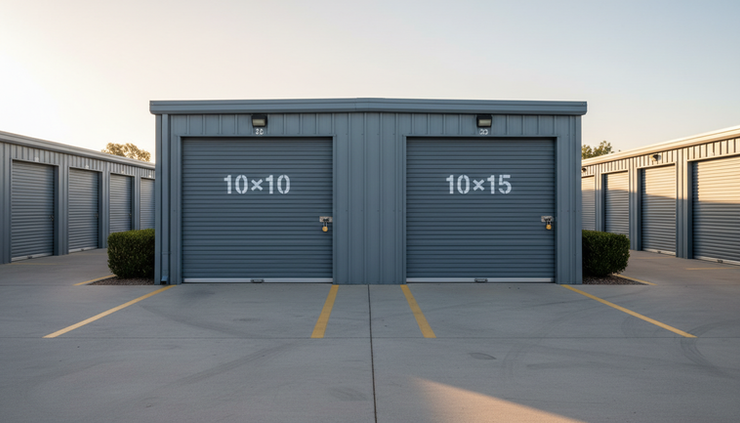
Price compression is a symptom, not the diagnosis
Price compression happens when two adjacent unit sizes move too close together in asking rent. In self storage pricing, this often appears between common sizes such as 5x10 and 10x10, 10x10 and 10x15, or 10x15 and 10x20.
A tight spread may be rational. It may also hide a revenue problem.
Take the hypothetical site:
Unit size | Asking rent | Inventory condition |
10x10 | $142 | Availability is tight |
10x15 | $149 | Available inventory is growing |
The 10x15 offers 50% more square footage for only $7 more per month. On a pure space basis, the 10x10 costs $1.42 per square foot. The 10x15 costs about $0.99 per square foot.
That difference will catch attention from some customers. It will also create trade-offs for the operator.
A customer who came in for a 10x10 may accept the 10x15 because the rent difference is small. That can help absorb 10x15 supply. But it may also train customers to see the 10x10 as a poor value. If the 10x10 is nearly full, that may not matter today. It can matter when availability turns.
A customer who needs a true 10x15 may be less price-sensitive. If so, keeping the rate near the 10x10 may leave money on the table.
A competitor may be creating the compression. If nearby stores price 10x15s aggressively, the facility may have matched the market while 10x10 demand stayed strong. In that case, the 10x15 rate may be market-constrained, even if it looks wrong inside the facility’s own rate card.
The rate relationship is a clue. It is not the answer.
The first question is what each size is being asked to do
Adjacent sizes do not serve identical roles. The 10x10 is often the workhorse of a facility. It fits household overflow, apartment moves, small business storage, and seasonal use. It is easy for customers to understand.
A 10x15 is different. It may serve as an upgrade from a 10x10, a substitute for a 10x20, or a landing point for customers who need furniture storage during a larger move. It has more space, but it may not have the same search demand or the same mental availability.
That matters because incremental space value is not linear.
Customers do not always value 50% more square footage at 50% more rent. They value a unit that solves the job. If the extra five feet of depth helps them store a longer sofa, business equipment, or the contents of a larger home, the value can be high. If they only need a standard bedroom set and boxes, the extra space may feel irrelevant.
The same unit can be an upgrade, a bargain, or excess capacity depending on the customer’s use case.
That is why a $142 10x10 and a $149 10x15 may be right for a short period. The 10x15 may need help moving. The 10x10 may already be full enough to support higher pricing. But the spread should not be ignored. It should be tested against current demand signals.
Key questions:
Is the 10x10 renting faster than expected at $142?
Is the 10x15 failing to rent at $149?
Are 10x10 prospects converting into 10x15 rentals?
Are 10x15 prospects shopping competitors first?
Is the 10x15 inventory concentrated in less desirable locations, such as upper floors, long walks, or units without drive-up access?
Did prior rate increases hit one size harder than the market could support?
These answers will point to different actions.

The answer is not automatically to raise one or lower the other
A compressed spread creates pressure to “fix” the rate card. That response can be too narrow.
If the 10x10 is tight and the 10x15 is building inventory, one obvious move is to raise the 10x10. Another is to lower the 10x15. Both could be wrong.
Raise the 10x10 too quickly, and the facility may slow rental velocity on its most reliable size. If the 10x10 already sits above key competitors, the next increase may push prospects to alternatives. The facility may gain a few dollars on new rentals while losing move-ins.
Lower the 10x15 too quickly, and the site may deepen the value gap. Customers who would have paid more for the larger unit now get a bigger discount. The lower price may also pull demand away from 10x10s, which creates artificial tightness in one size and delayed pressure in another.
The rate action should match the cause.
If 10x10 availability is tight because the site has only a few units left, a higher rate may make sense. Scarcity has value. But if tightness comes from a temporary move-in wave that will reverse next month, a steep rate increase may overcorrect.
If 10x15 inventory is growing because demand is weak across the submarket, a lower web rate or targeted concession may be needed. But if inventory is growing because prior increases went too far, the better correction may be smaller and staged. If inventory is growing because the site has too many 10x15s in its unit mix, pricing alone may not solve the issue.
Revenue management should separate these causes before changing the rate.
Rental velocity often tells the truth before occupancy does
Occupancy is useful, but it is a rearview metric. Rental velocity reveals current demand.
For the $142 and $149 example, the occupancy gap may not be enough. A 10x10 can be tight because it was built with limited inventory. A 10x15 can show rising availability because it has more total units. The better view includes:
New rentals by size over the last 7, 14, and 30 days
Web leads and reservations by size
Quote-to-rental conversion by size
Cancellations and no-shows by size
Days vacant by size
Move-outs by size
Street rates and promotions by nearby competitors
If the 10x10 keeps renting quickly at $142 and prospects rarely reject the price, the rate may be low relative to demand. If the 10x15 is getting views but not rentals, the rate, presentation, or competitor position may be the issue.
If prospects are choosing the 10x15 after originally searching for a 10x10, the $7 spread may be doing useful work. It may be steering customers into available supply. That can be smart when 10x10 inventory is tight.
But the facility still needs to watch what happens next. If the 10x15 begins to rent faster and availability falls, the spread may need to widen again. If 10x10 leads fall sharply after a rate increase, the site may have crossed a market threshold.
The right rate is not static. It changes as evidence changes.
Customer substitution can help or hurt the price architecture
A small gap between sizes changes customer choice.
Some substitution is valuable. If a site is nearly sold out of 10x10s and has too many 10x15s, a tight spread can shift demand to the larger units. That protects occupancy and may improve customer satisfaction because the customer gets more room with little friction.
But substitution can also distort price architecture.
Price architecture is the pattern customers see across the rate card. It should make intuitive sense. Larger units should usually cost more than smaller units. Better features should usually support higher rates. Scarcer products should reflect scarcity. The pattern does not need rigid gaps, but it does need coherence.
When the pattern breaks, customers notice.
If a 10x15 is only $7 more than a 10x10, a customer may ask why the 10x10 is so expensive. If a 10x20 is $229, the same customer may ask why the jump from 10x15 to 10x20 is so large. One compressed gap can make another gap look unreasonable.
That does not mean every adjacent size needs a fixed spread. Fixed gaps ignore local conditions. They also ignore the fact that demand is not evenly distributed across units. A site may need a tight gap between 10x10 and 10x15 while keeping a wider gap elsewhere.
The goal is not mathematical symmetry. The goal is a rate structure that supports revenue, protects conversion, and makes sense to customers.

Competitor relationships can explain the compression
Internal rate comparisons matter. External comparisons matter just as much.
A 10x10 at $142 and a 10x15 at $149 may look compressed inside the facility. In the local market, each rate may sit in a different competitive position.
Possible scenarios include:
The 10x10 is below nearby competitors, which explains tight availability.
The 10x15 is at or above nearby competitors, which explains growing inventory.
Competitors have limited 10x10 supply, pushing demand toward the facility.
Competitors are discounting larger units, forcing pressure on 10x15 pricing.
A new facility nearby has introduced aggressive web rates on common sizes.
The subject facility has a location or access advantage that supports a premium in one size but not another.
This is why unit size pricing should not rely only on a facility’s internal grid. A rate that looks low compared with an adjacent size may still be high compared with competitors. A rate that looks high internally may be justified if the market is sold out.
Competitor data also needs context. A low advertised rate may include admin fees, insurance requirements, short-term promotions, or limited availability. A high rate may reflect climate control, access, security features, or location quality. The relationship matters more than a single scraped number.
Good pricing reads the market and the facility together.
Prior rate actions may have created the imbalance
Price compression often has a history.
Maybe the 10x10 received several increases because demand was steady. Maybe the 10x15 was held flat because occupancy lagged. Maybe an automated rule raised one size but skipped another due to availability thresholds. Maybe a manager manually moved one rate after a competitor change.
None of those actions are wrong by default. Over time, they can create a rate card that no longer reflects current conditions.
The audit should look backward before taking action forward:
What was the spread 30, 60, and 90 days ago?
Which size changed most recently?
Did rental velocity change after the last move?
Did competitor rates move at the same time?
Did availability change because of move-ins, move-outs, or transfers?
Did concessions or web-only rates affect customer behavior?
Past actions do not prove causation. But they help prevent repeated mistakes. If a 10x15 rate increase slowed rentals last month, raising it again to restore a prettier gap may worsen the problem. If a 10x10 increase had no effect on conversion, the site may have more room.
The rate card carries memory. Good controls read it.
A practical way to read the $142 versus $149 example
The best decision comes from a short diagnostic, not a reflex.
For the hypothetical facility, start with five checks.
Check availability by true sellable count.
If only two 10x10s remain and 20 10x15s remain, scarcity supports a different posture than a site with 12 and 16 available.
Check rental velocity.
If 10x10s rent within days and 10x15s sit for weeks, the current spread is not clearing the larger size fast enough. If 10x15s have started to rent after the spread tightened, the strategy may be working.
Check customer paths.
Look for calls, reservations, and web behavior that show customers switching from 10x10 to 10x15. Substitution can be intentional. It should be measured.
Check local competitors.
Compare like-for-like units where possible. Climate, access, floor, drive-up, elevator use, and location all change the relationship.
Check the rest of the grid.
The 10x10 and 10x15 cannot be priced in isolation. A change may affect 5x10, 10x20, and parking demand. It may also change how customers perceive value across the unit mix.
After that review, several actions could be valid.
The site may raise the 10x10 modestly if demand is strong and competitors allow it. It may hold the 10x10 and test a targeted 10x15 offer if larger units are not moving. It may raise the 10x15 if rental velocity has improved and availability is falling. It may leave both rates alone for a short window if the compressed spread is successfully shifting demand into excess inventory.
Each action can be correct under different facts.

FAQ
Should a 10x15 always cost much more than a 10x10?
No. A 10x15 usually should cost more, but the spread should reflect demand, availability, competitors, and customer behavior. A fixed gap can miss the market.
Does tight 10x10 availability mean the rate is too low?
It can. Tight availability may also reflect limited supply, a short-term demand spike, or competitor shortages. Rental velocity and conversion data should confirm the signal.
When should a facility lower the 10x15 rate?
Lowering may make sense when availability is rising, rental velocity is weak, and competitor positioning shows the rate is above the market. A concession or targeted offer may work better than a broad rate cut.
Can a compressed spread be intentional?
Yes. A tighter spread can steer demand from a scarce size into a size with more availability. The tactic needs monitoring so it does not damage the larger price structure.
What metric matters most in this decision?
No single metric is enough. The best read combines availability, rentals, leads, conversion, move-outs, customer substitution, and local competitor rates.

Keep the rate card coherent and connected
A near match between a 10x10 and 10x15 is not a failure by itself. It is a prompt to inspect the system.
The right answer may be to raise one rate, lower the other, adjust a promotion, hold steady, or reframe how the facility presents available options. The decision should come from connected data, not a target spread.
A.R.M.S. Revenue Intelligence approaches these questions by linking facility performance, customer behavior, and market intelligence in one pricing view. That helps operators see whether compression reflects opportunity, risk, or a deliberate bridge between demand and supply.
To see how A.R.M.S. connects pricing decisions with market context, visit A.R.M.S. Revenue Intelligence.
The takeaway is simple. When two adjacent sizes nearly match, do not ask which rate looks wrong first. Ask what the relationship reveals. Then price the facility the way customers and the market are actually behaving.


Comments